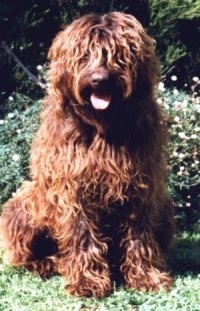
Barbet

The Barbet is a breed of dog, it is a medium-sized French water dog. It was taken out of the gun dogs (7th group) in the mid- 80's.

Appearance

Barbet appearance

Weight: 17-28 kg 35-60 pounds
Height: 52-65 cms 20.5-25.5 inches
Coat: Curly and woolly
Litter size: 6-9 puppies
Life span: 13-15 years

Two Barbets - females

The breed stands 58 to 65 cms (20.5-25.5 inches) for the males in height, 52 to 61 for the females with a tolerance of 1 cm +/- and weighs 17 to 28 kg (35-60 pounds). Many breeders are trying to keep its original morphology by keeping the height at the lower end of the scale. The Barbet is a prototypic water dog, with a long, woolly and curly coat. Their coats grow long and must be groomed regularly, otherwise the barbet may lose small tufts of hair like tumbleweeds.

The accepted colours of the breed are solid black, brown, fawn, grey, pale fawn, white or more or less pied. All shades of red-fawn and pale fawn are permitted. The shade should, preferably, be the same as the colour of the body. Grey and white are extremely rare; mixed colours (except with white) are considered as a fault. The most common colors being black or brown with white markings. The birth figures worldwide for 2007 are 176. All born were black or brown some with white markings on chest, chin, and legs.

Temperament

The Barbet’s personality is described as companionable, joyful, goofy, obedient, and intelligent. They are quick to learn and need obedience training. They are a great with children, families, and the elderly.

They are capable retrievers for waterfowl hunting. The do field trials in Germany and only water trials in France.

Health

Due to the extremely low number of Barbet in the world, little is known about long term health issues. Some issues that have exhibited themselves are ear infections, hip dysplasia, hernias, undescended testicles, undershot/overshot bites, and epilepsy.

Of the few health issues that have exhibited themselves, most problems can be traced back 4-6 generations. Often this is due to limited breeding stock.

The most common of these issues are ear infections, a problem in most water dog varieties. Ear problems can be minimized by proper ear care. A veterinarian should be consulted if the dog shows signs of an ear infection.

Lifespan of the Barbet averages 13-15 years with one recently passing away at age 19.

History

Barbet circa 1915

The Barbet breed is an integral part of dog history, and many familiar breeds have Barbet in their ancestry. Depending on geography and necessity, the Barbet connected through the centuries in various capacities, and as a companion dog, but more as an all-around working dog. The name Barbet became throughout centuries a "generic" name for a dog with a long woolly coat

The Grand Barbet de Buffon (1750)is thought to be the original source of the various water dog breeds (Poodle, Portuguese Water Dog, American Water Spaniel, and so on). Its actual origin is lost in antiquity but probably stems from corded herding stock and definitely Griffon hounds (griffons are dogs with hair over their eyes and a beard). The breed is gaining popularity in Scandinavian countries and North America as more and more people are becoming interested in this all-around working dog or just as a pet.

The Barbet is a French water dog and the breed's name “Barbet” comes from the French word barbe, which means beard. It has been said that the French Royals had hunted with Barbets. The Barbet has also worked as sailor’s assistants, much like the Portuguese Water Dog.

The versatile nature of the Barbet has meant its survival, and today's Barbet still has the assets attributed to it from the past and the Barbet origines and bloodlines can be traced back to the writing of the first standard in 1891.

Current status in the United States

There are very few barbet in the United States. Estimated as of 2009 are less than 47 known barbet. Steps are being taken to slowly increase barbet in the States. Currently, barbets may be fully registered in the United States with ARBA or the UKC, and there has been a recent acceptance in the AKC Foundation Stock Service Program. According to the AKC, to get full recognition there needs to be at least 300 barbet to apply. Every barbet registered with the AKC FSS program is helping the barbet get to that goal. In 2007, there were 8 barbet born in the United States with the common color being black and secondary is brown. The year 2008 had no barbet births in America. Currently for 2009, there has been one litter of 6.


Azawakh

The Azawakh is a sighthound dog breed from Africa.

Appearance

His morphology is very close to that of the Middle Eastern and of the North African sighthounds, all swift, highbred coursing hounds, although at first glance obvious physical singularities present themselves. For example, a short, flat back atop long legs accentuates his lofty bearing, and his hips appear higher than the withers. His natural beauty is austere and architectural, sharply contrasting the arabesque loveliness of the Saluki, or the rather somber dignity of the Sloughi. Almond eyed, lean and graceful, his profile is at once sere but harmonious, his presence aristocratic and aloof. He moves with a distinctly feline plastique, collected, elastic, and articulate, his demeanor guarded and mysterious, his glance feral, untamed. In his land of ancestry he can be found in a variety of colors as well as varying degrees of refinement, though format is basically constant.

The standards call for a hound from 33 to 55 pounds (15 to 25 kg); its height is 24 to 29 inches (61 to 74 cm). The coat is very short and almost absent on the belly. Its bone structure shows clearly through the skin and musculature. Its muscles are "dry", meaning that they lie quite flat, unlike the Greyhound and Whippet. In this respect it is similar in type to the Saluki.

In Africa, Azawakh are found in a variety of colors such as red, blue fawn (that is, with a lilac cast), grizzle, and, rarely, blue and black. The Azawakh in its native land also comes with various white markings including Irish marked (white collar) and particolour (mostly white). Because of this wide color variation in the native population, the American standard used by the AKC and UKC allows any color combination found in Africa. In the United States, the FCI standard is modified to have no color restrictions at a minimum and there is a strong sentiment that the FCI standard should be heavily edited or replaced.

Colors permitted by the FCI breed standard are clear sand to dark fawn/brown, red and brindle (with or without a dark mask), with white bib, tail tip, and white on all feet (which can be tips of toes to high stockings). Currently, white stockings that go above the elbow joint are considered disqualifying features in France, as is a white collar or half collar (Irish marked).

The Azawakh’s light, supple, lissome gait is a notable breed characteristic, as is an upright double-suspension gallop.

Health

Azawakhs are an incredibly sound coursing hound. Serious coursing injuries are rare. The dogs heal very quickly from injury.

Azawakh have no known incidence of hip dysplasia. There is a small occurrence of adult-onset idiopathic epilepsy in the breed. Wobbler disease or cervical vertebral instability does rarely occur. Some breeders believe this is a largely developmental problem where puppies grow too quickly due to a high-protein western diet.

Like the Basenji, the Azawakh bitch often has a single annual estrus. Unassisted birth of healthy puppies is the norm. Litter sizes are usually from 4 to 6 puppies but litters as small as 1 and as large as 8 occur.

Azawakh need a fairly high level of exercise and should have regular runs off lead in large enclosed areas to run off steam. The dogs are very social and emotional. They need a master that provides firm but fair leadership. Azawakh thrive companionship of other Azawakh.

Temperament

Unlike other sighthounds, the primary function of the Azawakh in his native land is that of protector. He develops an intense bond with his owner, yet does not look to his master for instructions. Azawakh are a study in opposing tensions: attentive yet aloof, affectionate yet fierce, refined yet rugged. With those they accept, Azawakh are gentle and extremely affectionate. With strangers many are reserved and prefer not to be touched, but are not inherently aggressive. Although raised to protect livestock, they do not have innate aggression toward canine nor human unless they are threatened.

Azawakh have high energy and tremendous endurance. They are excellent training companions for runners and are nearly impervious to heat. They will happily run in weather over 100 degrees Fahrenheit that would kill a Greyhound. They love to dig holes in the garden, which is great exercise for both dog (digging) and owner (filling).

Many Azawakh detest rain and cold weather.

Azawakh are pack oriented and form complex social hierarchies. They have tremendous memories and are able to recognize each other after long periods of separation. They can often be found sleeping on top of each other for warmth and companionship.

Origin

Recent genetic, blood protein and archaeological studies as well as direct observation in the field offer a glimpse into the origin of the contemporary Azawakh breed. He comes out of the population of pariah dogs of sub-Saharan Africa—also called bush dogs or senji--and is also closely related to the Sloughi of the Maghreb. Despite morphological similarities, mitochondrial DNA evidence shows that he is only very distantly related to other sight hounds. Azawakh have a rare glucose isomerase allele (GPIB) that occurs only in foxes, jackals, Italian wolves, Sloughi dogs and a handful of other quite unrelated rare dogs found mostly in Japan. The presence of the GPIB suggests an ancient differentiation of the Azawakh from other dog populations near the base of the dog family tree divergence from wolves or perhaps a uniquely African cross-breeding with local African canids such as jackals. Petroglyph rock art dating from 8,000 to 10,000 years ago during the Green Sahara (also known as the Holocene and Neolithic Subpluvial) shows cursorial dogs in conjunction with hunters. Archaeologists have found dog bones buried in Holocene settlements in the Sahara. At the close of the Holocene Wet Phase in the 4th millennium Before Christ, the Sahara returned to desert and created a formidable physical barrier to travel. Together, this evidence suggests that the Azawakh population has a unique genetic heritage that has been largely isolated from other dog populations for millennia.

In the common era the Sahel dogs are almost totally isolated from northern dogs by the Sahara, but the ties to the pariah dogs to the south are extremely close. Azawakh are virtually indistinguishable from the Sahel pariah dog population from which they are drawn. In addition to a basic physical structure, the Azawakh share a number of unique traits with the pariah dogs:

  • intense suspicion of the unknown
  • strong guarding instinct
  • pack hunting behavior
  • complex social hierarchies
  • unique vocalizations
  • extra pre-molar teeth
  • strong instinct to dig dens

Throughout the Sahel, very elegant puppies can be found among rustic siblings. The Sahel nomads do not have the same breed concepts as in the West and, unlike the Bedouin of the North, do not recognize a strict separation of al hor (noble) from kelb (mongrel) dogs. The nomads act as an extra level of selection on top of the intense natural selection pressure of the Sahel environment. The approach to selection is diametrically opposed to Western breeding. Instead of selecting which dogs to breed upon maturity, they decide which puppies should live. This approach has the advantage of maintaining a large reservoir of genetic variability and resilience.

The peoples of the Sahel control dam lines and cull puppies heavily at birth according to locally held aesthetic criteria that we do not fully understand. In the Sahel, color is not a selection criterion. The alpha male dog from the local population is usually the sire. Unless it is a wet year, only one puppy from a litter might be selected to live. Females are usually culled unless the family projects a need for more dogs in the future.

History

Azawakh among the Tuareg

Bred by the Tuareg, Fula and various other nomads of the Sahara and sub-Saharan Sahel in the countries of Mali, Niger, Burkina Faso, and southern Algeria, the breed is used there as a guard dog and to hunt gazelle and hare at speeds up to 40 miles per hour. The austerity of the Sahel environment has ensured that only the most fit dogs survive and has accentuated the breed's ruggedness and independence. Unlike some other sighthounds, the Azawakh is more of a pack hunter and they bump down the quarry with hindquarters when it has been tired out. In role of a guard dog, if an Azawakh senses danger it will bark to alert the other members of the pack, and they will gather together as a pack under the lead of the alpha dog, then chase off or attack the predator. The Sloughi, by comparison, is more of an independent lone hunter and has a high hunting instinct.

Map showing the breed's area of origin

They are relatively uncommon in Europe and North America but there is a growing band of devotees. Azawakhs have a range of temperaments from lap dog to quite fierce. Lifelong socialization and firm but gentle handling are critical. Well socialised and trained, they can be good with other dogs, cats, children, and strangers. Azawakh may be registered with the FCI in the USA via the Federación Canófila de Puerto Rico (FCPR). European FCI clubs and the AKC recognize the FCPR as an acceptable registry. The AKC recognizes Azawakh as a Foundation Stock Service breed and they are eligible to participate in AKC-sanctioned performance events. Azawakh may be registered with the UKC and ARBA. The breed is not yet registered by CKC. Azawakh are eligible for ASFA lure coursing and NOFCA open field coursing events.


Austrian Pinscher

The Austrian Pinscher (Österreichischer Pinscher, FCI No. 64) is a medium large breed of pinscher-type dog from Austria, where dogs of the type were originally farm dogs, keeping barns free of rats and acting as home guards, livestock guardians, and drovers. The name originally given to the breed in 1928 was the Österreichischer Kurzhaarpinscher (Austrian Shorthaired Pinscher) to differentiate it from similarly named breeds, but today in its country of origin the breed is officially called the Österreichischer Pinscher, or Austrian Pinscher in English.

Appearance

Like other farm dogs raised for work rather than for pets or show, the appearance can vary a great deal, although there is a definite breed standard. In general, the Austrian Pinscher is a normally proportioned strong and sturdy dog, 33 - 48 cm (13 - 19 inches) at the withers. The breed has button ears and a head described as being shaped like a pear. The double coat is short to medium long, in a variety of yellow, red or black and tan colours, usually with white markings on the face, chest, feet and tip of the tail. The long tail is held high, and dogs of this breed should look lively and alert. They are heavier, more rugged and rectangular in appearance than the German Pinscher.

History

The Austrian Shorthaired Pinscher was recognised as a breed for the first time in 1928, but the breed was developed from an old type of pinscher found on farms in the Austrian countryside, a mixture of German Pinschers and the local dogs. Claims of great antiquity have been made for the old pinscher type. Since there are no records, it is not possible to tell how the old type is related to the modern-day breed, although they do look somewhat similar.

At the end of the 1800s, the farm dogs began to die out when the work they did was no longer needed. In the early 1900s Emil Hauck, looking for an aboriginal dog type identified in 1843 by H. von Meyer as Canis palustris or dog of the marshes (a type of dog, not an actual species), found what he believed were some examples of similar dogs in the Austrian countryside. In 1921 he began serious breeding to revive and define the type of the breed, to separate them from other landrace pinschers of the area. The Austrian Kennel Club (Austrian Kynologenverband) first recognised the breed as the Österreichischer Kurzhaarpinscher (translates in English as Austrian Shorthaired Pinscher) in 1928. The name was given to the breed to identify its place of origin as Austria ( Österreich), and to differentiate it from the Schnauzer which at that time was called the Rough-haired Pinscher (rauhaariger Pinscher). After World War II, though, the breed almost vanished. In the 1970s only one registered dog of the breed remained, named Diokles of Angern. Breeding this dog with other dogs identified as of the old pinscher type in the area ("Landpinschern") has brought the breed back, although there are still only a small number of them..

Ark Austria (Arche Austria), an association for the preservation of endangered indigenous breeds, lists the Austrian Pinscher and states that it is highly vulnerable, with only 6 to 12 breeding animals, who are being carefully bred to preserve health and breed type.

The breed is recognised in its country of origin by the Austrian Kynologenverband (ÖKV, Austrian Kennel Club) and internationally by the Fédération Cynologique Internationale in the Pinscher section of Group 2. It is also recognised by the United Kennel Club in the United States as the Austrian Pinscher as of 2006, in the Terrier Group, for its background as a rat hunter. In addition it is recognised by a number of minor kennel clubs and internet based dog registry businesses under a variety of translations of the name, who may rewrite the standard to suit producers of dogs for the rare breed pet market. Purchasers of puppies and dogs from groups outside the Austrian breed restoration program should read the original standard (obtainable in translation from the FCI) and their dog's pedigree to make sure they are buying an Austrian Pinscher and not an excessively inbred or a randomly bred dog.

Health

No data has been collected on the breed's health, but good health is a stated objective of the breed restoration breeding in Austria.

Temperament

The breed is described as "a pleasant companion" for rural and suburban areas. The breed standard describes the ideal Austrian Pinscher's temperament and character as playful, not inclined to be a hunter, and being an "incorruptible guard".

Australian Shepherd

The Australian Shepherd is a breed of herding dog that was developed on ranches in the Western United States. Despite its name, the breed, commonly known as an Aussie, did not originate in Australia. They acquired their name because of association with Basque sheepherders who came to the United States from Australia.

Australian Shepherds rose rapidly in popularity with the boom of western riding after World War II. They became known to the general public through rodeos, horse shows, and through Disney movies made for television.

For decades Aussies have been valued by stockmen for their inherent versatility and trainability. While they continue to work as stockdogs and compete in herding trials, the breed has earned recognition in other roles due to their trainability and eagerness to please, and are highly regarded for their skills in obedience. Like all working breeds, the Aussie has considerable energy and drive, and usually needs a job to do. It often excels at dog sports such as dog agility, flyball, and frisbee. They are also highly successful search and rescue dogs, disaster dogs, detection dogs, guide, service, and therapy dogs. And, above all, they can be beloved family companions.

Appearance

The breed's general appearance varies greatly depending on the particular line's emphasis. As with many working breeds that are also shown in the ring, there are differences of opinion among breeders over what makes an ideal Australian Shepherd. In addition the breed can be split into two distinct lines - working and show dogs. Working dogs tend to have shorter coats, thinner and are sometimes smaller while the show lines are bred according to breed standard and can have long fur.

Size

The Australian Shepherd is a medium sized breed of solid build. The standard calls for the Australian Shepherd to stand between 18-23 inches at the withers. Females being 18-21 inches and males measuring 21-23 inches

Color

Color variants: Black tricolor, red merle, blue merle, liver tricolor.

Aussie colors are black, red (sometimes called liver), blue merle (marbled black and gray), and red merle (marbled red and silver or buff); each of these colors may also have copper points and/or white markings in various combinations on the face, chest, and legs. A black or red dog with copper and white trim is called tricolor or tri, a black or red dog with white trim but no copper is called bicolor or bi. White should not appear on the body of the dog from topmost point of the shoulder blade to the tail. The ears should be covered by and completely surrounded by pigment other than white to decrease the risk for white related deafness. Eyes should also be surrounded by color, including the eye rim leather. Excessive white on the face and ears can place an individual dog at greater risk for sunburn and subsequent skin cancer. The wide variation of color combinations comes from the interaction between the a color allele, which is either black (B) dominant or red (b) recessive, and the dominant merle allele (M). Together, these provide four coat-color aspects that can appear in any combination:

  • Black Tri, with tan points and/or white markings on the face, collar, legs, chest, underbelly. Solid black dogs are equally desirable as ones with tan and/or white.
  • Red (Liver) with or without tan points and/or white markings on the face, collar, legs, chest, underbelly. Neither white nor tan points are required. Solid Red dogs are equally desirable as ones with tan and/or white.
  • Blue Merle (a mottled patchwork of gray and black) with or without tan points and/or white markings on the face, collar, legs, chest, underbelly. Neither white nor tan points are required. Solid Merle dogs are equally desirable as ones with tan and/or white.
  • Red Merle (a mottled patchwork of cream and liver red) with or without tan points and/or white markings on the face, collar, legs, chest, underbelly. Neither white nor tan points are required. Solid Merle dogs are equally desirable as ones with tan and/or white.

The merle allele, which produces a mingled or patchwork combination of dark and light areas, is the coat pattern most commonly associated with the breed. This merle (M) is dominant so that affected dogs (Mm) show the pigmentation pattern; however, when two merles are bred, there is a statistical risk that 25% of the offspring will end up with the two copies of the merle gene (homozygous). These dogs usually have a mostly white coat and blue irises, and are often deaf and/or blind. In this case, the deafness and blindness are linked to having two copies of the merle gene, which disrupts pigmentation and produces these health defects.

All black and blue merle dogs have black noses, eye rims, and lips. All red and red merle dogs have liver or brown noses, eye rims, and lips.

Red merle with copper points and one brown eye and one blue eye. Blue merle with copper points with blue eyes

There is also great variety in the Aussie's eye color. An early nickname for the breed was "ghost-eye dog". Aussie eyes may be green, hazel, amber, brown, or blue; they may have two different colored eyes, or even have bicolored or "split eyes" (for example, a half-brown, half-blue eye), which appear to be linked to the merle coloration. Merled eyes occur as well, where one color is mixed in and swirled with another. Any combination of eye color is acceptable in the breed standard, so long as the eyes are healthy. In general, however, black Aussies (self, bi-color or tri-color) tend to have brown eyes, while red (self, bi-color or tri-color) Aussies tend to have amber eyes, though these Aussies may also carry the blue eyed gene.

Tail

A hallmark of the breed is a short bobbed or docked tail in countries where docking is permitted. Some Aussies are born with naturally short bobbed tails, others with full long tails, and others with natural partial bobs, where the tail is midlength and appears stubby. Breeders have historically docked the tails when the puppies are born. Even without a tail, the wagging movement of the hind end still occurs.

Some Australian Shepherd breeders try to keep the tail on the dog for the natural look, which can still be shown in the breed ring.

Temperament

The breed is an energetic dog that requires exercise and enjoys working, whether it is learning and practicing tricks, competing in dog agility, or any other physically and mentally involving activity.

Dogs with strong working instinct may show more reserved, guarding behaviors along with a tendency to chase or nip at strangers. Its protective instinct and behaviors can be frightening to children, strangers, and small animals. They are kind, loving, and devoted to those they know. They are very loyal to their owners, and are rewarding dogs if treated well. Because the breed was developed to serve on the ranch, a job which includes being protective of its property, it is inclined to bark warnings about neighborhood activity, but it is not an obsessively barking dog.

The Aussie is intelligent, learns quickly, and loves to play. This means that a bored, neglected, unexercised Aussie will invent its own games, activities, and jobs, which to a busy owner might appear to be hyperactivity: for example, an Aussie may go from being at rest to running at top speed for several 'laps' around the house before returning to rest. Without something to amuse them, Aussies often become destructive. Aussies also do best with plenty of human companionship: they are often called "velcro" for their strong desire to always be near their owners and for their tendency to form intense, devoted bonds with select people. Recent studies have also shown that shepherds work well with special-needs kids and babies.

The Australian Shepherd has a reputation as a highly intelligent and versatile stock dog with a range of working styles. A good working Aussie is quick, thoughtful, and easy with its stock. The ability for the breed to adapt to the situation and think for itself makes it an excellent all-around worker. For this reason the Aussie is often chosen to work unusual livestock such as ducks, geese, and commercially raised rabbits.

The Australian Shepherd, though a great dog for a family with an abundance of time, can become extremely destructive if left alone, or in small spaces. They are known for digging holes, tearing up lawns, and chewing anything in sight if they become restless. These dogs require a minimum of 2-3 hours a day of play and exercise and need constant attention. The dogs thrive in rural, ranch like conditions, but would be a nightmare for any busy group of people living in a city or suburb. When restless, they will often try to "herd" their owners which may include excessive jumping, snapping, and biting.

Health

There are many health problems that an Australian Shepherd can acquire, including back and hip problems, vision problems, and pancreatic problems. Also, an Aussie can develop bladder problems and urinary infections over time. Many can be epileptic. Thyroid problems are also appearing.

Mortality

Results of a 1998 internet survey with a sample size of 614 Australian Shepherds indicated a median longevity of about 12.5 years, but that longevity may be declining. A 2004 UK survey found a much shorter median longevity of 9 years, but their sample size was low (22 deceased dogs).

The median life spans for breeds similar in size to Australian Shepherds are mostly between 11 and 13 yrs, so, assuming the results of the UK study are not representative of the population there, Aussies appear to have a typical life span for a breed their size. Leading causes of death in the UK survey were cancer (32%), "combinations" (18%), and old age (14%).

Morbidity

Based on a sample of 48 still-living dogs, the most common health issues noted by owners were eye problems (red eye, epiphora, conjunctivitis, and cataracts). Dermatological and respiratory problems also ranked high.

Collie eye anomaly (CEA) and cataracts are considered major health concerns[citation needed] in Aussies. Other conditions of note include iris coloboma, canine hip dysplasia (CHD), Pelger-Huet syndrome, hypothyroidism, and nasal solar dermatitis. Prior to breeding, the Aussie should be checked for Hip and Elbow Dysplasia, DNA tests performed to show the dog to be free of the MDR1 mutation, cataract mutation, and CEA. Tests should also include those for thyroidism and clearances for other known eye diseases like colobomas, PRA and retinal folds. The Australian Shepherd (as well as Collies, German Shepherds and many other herding dogs) are susceptible to toxicity from common heartworm preventatives (anti-parasitics) and other drugs[citation needed]. This is caused by a genetic mutation of the MDR1 gene[citation needed]. The most common toxicity is from the heartworm medicine Ivermectin found in products such as Heartgard[citation needed]. (Only at very high doses. Most dogs will not have problems with Ivermectin found in products such as Heartgard Plus.) A test is available to determine if a particular dog carries the mutated gene. Read here for more information.

Double Merle

Double merling or homozygous merle, also known as "lethal white" (a misnomer because it is not lethal), occurs when the resulting offspring of two merled parents inherit two copies of the dominant merle gene. Double merles are often mostly white and can have resulting hearing and vision problems as a result of having two copies of the merle gene. Homozygous merles can be deaf, blind, express iris colobomas and microphthalmia. Not all homozygous merles are affected, but most are, making the breeding of two merles ethically questionable. Breeders will either euthanize mostly white pups or in the case of poorly qualified breeders, sell them as "rare" white Aussies without disclosing the potential for health defects. A large percentage of homozygous merles sold eventually end up in rescue and shelters as the average family is ill prepared to take on a deaf and/or blind pet. However, deaf and/or blind Australian Shepherds can make wonderful pets given a home prepared for their special needs.

History

The Australian Shepherd's history is vague, as is the reason for its misleading name. It is believed by some the breed has Basque origins in Spain and was used there by shepherds. What is known is that it developed in western North America in the 19th and early 20th centuries.

An Australian Shepherd from non-standard working lines; early breeders chose dogs for their abilities rather than conformation.

Breeds as we know them today did not exist before Victorian times, but local variations of the ancestors of current breeds came into America along with their owners and livestock. Included are some that are now extinct or that have merged into other breeds. These may have included British herding dogs as well as dogs from Germany and Spain. For many centuries, shepherds had interest in dogs' working abilities rather than their appearance. As a result, over time, shepherds interbred dogs that they believed would produce better workers for the given climate and landscape. In the eastern U.S., Terrain and weather conditions were similar to that of Europe, however, so the existing imported breeds and their offspring worked well there.

In the American West, conditions were quite different. During the early introduction of sheep into America, the Spanish dogs that accompanied the flocks, proved well suited for their job in the new, wild and dangerous land. They were highly valued on the open range for their ability to herd and protect their charges from predators. In the arid and semiarid areas inhabited by early Spanish settlers, temperatures reached extremes of hot and cold, and fields varied in altitude from sea level to the higher, rougher Sierra Nevada and similar mountain ranges. The ranchers in these areas often pastured livestock on remote ranges. They preferred more aggressive herding dogs that served in the capacity of herder and guardian.

With the 1849 California Gold Rush, a massive migration occurred into to the west coast, and along with easterners came flocks of sheep and their eastern herding dogs; from the southwest came people and Spanish. But it was just as effective to bring sheep in by ship, and in they came, including flocks from Australia and other regions, along with shepherds and their own herding breeds.

Dogs from Australia had already begun to be selected and bred for climates and terrains that were often similar to California.

It is not clear where the name "Australian" came from, although it is possible that many of the dogs coming from Australia were blue merle and the adjective "Australian" became associated with any dogs of that coat color.

Recent history

Development of the breed began in Arizona, California, Colorado, Idaho, Nevada and the Pacific Northwest. The breed's foundation bloodlines are depicted in the Australian Shepherd Genealogy Chart showing the relationship between the early families of dogs.

Selective breeding for many generations focused on aspects of the dog that enabled it to function as an effective stockdog in the American west. It had to handle severe weather; have plenty of speed, athleticism, energy, and endurance; and be intelligent, flexible, and independent while remaining obedient. The actual foundation for the Australian Shepherd was established between 1940s and the early 1970s, when the Australian Shepherd Club of America was formed and the registry was started. They became popular as performing dogs in rodeos. Their stunts and skills earned them places in several Disney films, including Run Appaloosa Run and Stub: The Greatest Cowdog in the West.

Activities

A blue merle in a dog agility competition

Like other herding breeds, these dogs excel at many dog sports, especially herding, dog agility, frisbee, and flyball. The dog has a stride in which its front and back legs cross over, making for an appearance of "on the edge" speed. The dogs instinctively use a "pounce" position to deal with cattle trying to kick them. They also have strong hips and legs, allowing for fast acceleration and high jumping, sometimes as high as 4 ft (1.3m).

An Australian Shepherd named Pockets is credited as being the oldest dog to earn a title in AKC history, having earned the Rally Novice title at the age of 15 years, 5 weeks.

Miscellaneous

The Australian Shepherd Club of America ASCA was founded in 1957 to promote the breed. The National Stock Dog Registry became its official breed registry, which continued until ASCA took over in 1972.

In 1975, ASCA created a breed standard, describing exactly how an Australian Shepherd should look and be constructed (its conformation to the Standard). It developed more uniformity in the breed and standardized the type.

In the United States, the American Kennel Club is the primary registry for purebred dogs. However, many Aussie breeders felt that AKC put too much emphasis on breed conformity and not enough on performance, so ASCA declined to join the AKC. Those breeders who felt that AKC membership had its advantages split off from ASCA to form their own Australian Shepherd club, the United States Australian Shepherd Association, created their own breed standard, and joined the AKC in 1993. The decision about affiliation with the AKC remains controversial, as it does with many performance breeds.

The Fédération Cynologique Internationale recognized the Australian Shepherd for international competition in 2007, in Group 1 Sheepdogs and Cattle Dogs as breed number 342. An Australian Shepherd Dog from Latvia competed in the Fédération Cynologique Internationale Agility World Championships in Helsinki, Finland in 2008.

In addition to the Miniature Australian Shepherd, the western United States are now seeing the emergence of an even smaller version, referred to as the Toy Australian Shepherd, with adult males tipping the scales at a mere 12 to 15 pounds (5.5 to 7 kg). The genetic consequences of breeding the standard Australian Shepherd down to one-quarter size remain to be seen. Many breeders and owners of Australian Shepherds consider the Mini and Toy to be separate breeds; others consider them to be downsized versions of the same breed. ASCA and AKC considers all such variants to be separate breeds.

Australian Labradoodle

Note: there are three different types of Labradoodles currently being bred, the Australian Labradoodle bred in Australia, the Australian Labradoodle bred in the USA and the American Labradoodle.

1. The Australian Labradoodle bred in Australia and recognized by the Labradoodle Association of Australia and the International Australian Labradoodle Association, Inc, is being bred with the goal of creating a purebred dog in mind. It is unclear how far the Australians have come in their development.

2. The American Labradoodle is a hybrid dog, bred by crossing the Poodle with the Labrador Retriever.

3. Some breeders are calling multi-generation Labradoodle's Australian Labradoodles (sometimes there are other breeds mixed in besides Lab and Poodle). Multi-generation Labradoodles are hybrids and are different than the ones being bred by the Australian clubs.

The dogs pictured in this info section are the Australian Labradoodles bred in Australia, with the goal of creating a purebred dog in mind. When contacting a breeder selling Australian Labradoodles, be sure to ask what type of Labradoodle they have.

Temperament

The Australian Labradoodle is good with children and are easy to train. They get along well with other dogs. Extremely clever, sociable and joyful. Quick to learn unusual or special tasks. Active, a little comical at times. Can attempt to outsmart their owners if undisciplined. It is very important that you are this dogs firm but calm, consistent pack leader and provide him with daily mental and physical exercise to avoid behavior issues. Friendly, though obviously loyal to their own family. Non-aggressive.

Height, Weight

Standard: Height - 22-24 inches (53-60 cm.)
Standard: Weight - Female - 45-60 pounds (20-27 kg.) Male - 55-77 pounds (25-35 kg.)
Miniature: Height - 17-22 inches (44-56 cm.)
Miniature: Weight - 30-50 pounds (14-25 kg) Males being the larger.

Health Problems

HD, PRA, VonWilabrands, Elbow and patella disorders.

Living Conditions

The Australian Labradoodle will do okay in an apartment if it gets enough exercise. They are moderately active indoors and will do best with at least an average-sized yard.

Exercise

This breed needs a lot of exercise, which include long daily walks.

Life Expectancy

About 13-15 years.

Grooming

Curly Coats need regular grooming with a slicker brush at least each two weeks and maybe two to three times a year, a trim, scissoring or clipping to keep tidy. Most Australian Labradoodles shed little to no hair and are possibly non-allergenic.

Origin
This classic example of logical and planned cross breeding was created in the country of Australia in the 1980's. The goal of the Australian clubs is to create a new "breed" with the best attributes of the original breeds. Wally Conron's objective was to produce assistance dogs that do not shed hair (for people with allergies). Australian Labradoodle guide dogs have been successfully trained and placed in Australia and Hawaii, but as yet the non-shedding characteristic of the Standard Poodle has not become a fixed a tribute. The Australian Labradoodle started out as a simple cross between the Labrador Retriever and Standard Poodle or Miniature Poodle and is still widely the case in North America. Australian's, on the other hand have taken the Labradoodle a few steps further. In mid 2004 it was announced that the Australian Labradoodle was not just a Labrador x Poodle cross but was a breed in its own right developed over many years with particular goals in mind. To accomplish these goals, further development was done with parent breed infusions added to the already blooming Labrador x Poodle cross lines. The developers of the breed sought out the best way in which to compliment the Australian Labradoodle breed, and to develop the qualities that they find and love in these dogs. In 1997 the very first Australian Labradoodle Breed Standard was written which reflected these goals. The Australian Labradoodle currently consists of 6 different breeds in its origin. The Confirmed and Approved Parent Breeds of the Australian Labradoodle are the Poodle (Standard, Miniature, Toy, Labrador Retriever, Irish Water Spaniel, Curly Coat Retriever, American Cocker Spaniel and English Cocker Spaniel.

Australian Labradoodles

Australian Labradoodles. Photo Courtesy of Tegan Park Labradoodle, Breeding & Research Center, Yarragon Australia.

Australian Labradoodle
Rutland Manor Labradoodles
.

Australian Labradoodle Puppies

Photo Courtesy of Tegan Park Labradoodle. Breeding & Research Center, Yarragon Australia

.

Australian Labradoodle

Photo Courtesy of Tegan Park Labradoodle, Breeding & Research Center, Yarragon Australia.

Australian Labradoodle

This is Zeb. He came all the way from Rutland Manor in Australia to the USA.

Australian Labradoodle

Zeb, the Australian Labradoodle.

Australian Labradoodle

Zeb, the Australian Labradoodle.

Australian Labradoodle

Photo Courtesy of Rutland Manor Labradoodles, breeder.

Australian Labradoodle

Photo Courtesy of Rutland Manor Labradoodles, breeder.

Australian Labradoodle

Photo Courtesy of Rutland Manor Labradoodles, breeder.

Australian Labradoodle

Photo Courtesy of Rutland Manor Labradoodles, breeder.

Australian Labradoodle

Photo Courtesy of Rutland Manor Labradoodles, breeder.

Australian Labradoodle

Photo Courtesy of Rutland Manor Labradoodles, breeder.


Australian Kelpie

The Kelpie is an Australian sheep dog successful at mustering and droving with little or no command guidance. They are medium-sized dogs and come in a variety of colours. Kelpies have been exported throughout the world and are used to muster livestock, primarily sheep, cattle, goats and poultry. The breed has been separated into two distinct varieties: the show or bench Kelpie and the working Kelpie.[citation needed] The show Kelpie is seen at conformation dog shows in some countries and are selected for appearance rather than working instinct. Working Kelpies are bred for working ability rather than appearance.

Appearance

The variety of colouration and coat types puts the Kelpie in a select group, as it is not possible to look at an unidentified dog and classify it as a Kelpie.[citation needed] Not a currently recognised breed, Kelpies referred to as Red Cloud Kelpies have red features with white markings on the face, chest, and feet.

Breed standards

Breed standards vary depending on whether the registry is for working or show Kelpies. It is possible for a dog to do both, but his options for competition in conformation shows might be limited depending on his ancestry and on the opinions of the various kennel clubs or breed clubs involved.

In Australia, there are two separate registries for Kelpies.[citation needed]

Working Kelpies are registered with the Working Kelpie Council (WKC), which is the primary authority on the breed standard, and/or the State Sheepdog Workers Association. The WKC encourages breeding for working ability, and allows a wide variety of coat colours. The Working Kelpie cannot be shown, due to the wide standards allowed by the WKC. Show Kelpies are registered with the Australian National Kennel Council, that encourages breeding for a certain appearance and limits dogs to certain colours. Only Show Kelpies may be shown in Australia.

Breed Standards Outside Australia

In the USA, the Kelpie is not recognized as a breed by the American Kennel Club (AKC). The North American Australian Kelpie Registry, which promotes the dog as a working breed, does not want the breed to be promoted by the AKC. Kelpies are recognized by the United Kennel Club (UKC) in the United States and may compete in UKC events. The Svenska Working Kelpie Klubben also does not permit Working Kelpies to be shown.

Working Kelpies

Kelpie walking across the backs of sheep

An Australian Kelpie competing in a cattle dog trial, Woolbrook, NSW.

Kelpie going back down a race to move the sheep forward.

The working Kelpie comes in three coat types, smooth, short, and rough, with almost every colour from black through light tan or cream. Some Kelpies have a white blaze on the chest, a few have white points. Kelpies sometimes to have a double coat, which sheds out in spring in temperate climates. Agouti is not unusual, and can look like a double coat.

Working Kelpies stand about 50 cm (19.5 inches) at the withers for females, 55 cm (21.5 inches) for males; weight would be between 14–21 kg (31-46 lbs). Ears are pricked, but a few will have one or both ears flopped; the tail will often follow the coat type, and will vary between smooth to bushy. The dog's working ability is unrelated to appearance, so stockmen looking for capable working dogs disregard the dog's appearance.

A working Kelpie can be a cheap and efficient worker which can save farmers and graziers the cost of several hands when mustering livestock. The good working Kelpies are heading dogs that will prevent stock from moving away from the stockman. This natural instinct is crucial when mustering stock in isolated gorge country, where a good dog will silently move ahead of the stockman and block up the stock (usually cattle) until the rider appears. The preferred dogs for cattle work are Kelpies, often of a special line, or a Kelpie cross. They will drive a mob of livestock long distances in extremes of climates and conditions. Kelpies have natural instincts for managing livestock. They will work sheep, cattle, goats, pigs, poultry, and other domestic livestock. The Kelpie's signature move is to jump on the backs of sheep and walk across the tops of the sheep to reach the other side and break up the jam. A good working Kelpie is a versatile dog—they can work all day on the farm, ranch, or station, and trial on the weekends. Kelpies compete and are exhibited in herding trials, ranging from yards or arenas to large open fields working sheep, goats, cattle, or ducks.

Show Kelpies

Show Kelpies are restricted to solid colours (black, chocolate, red, smoky blue, fawn, black and tan, red and tan) in a short double coat and pricked ears. Different kennel clubs'[citation needed] breed standards have preferences for certain colours. Show Kelpies are generally heavier and shorter than working Kelpies.[citation needed]

Temperament

Kelpie competing in a dog jumping class

Kelpies are loyal, friendly, intelligent, energetic dogs that require a challenging job to be satisfactory companions.[citation needed] They need to be stimulated as idle and bored dogs become frustrated, noisy, and destructive.[citation needed] With personalised love and attention, they can be very placid and faithful, although they do need space to run.[citation needed] For the show or bench Kelpie, walks and socialisation may be sufficient to keep them happy.[citation needed] A working bred Kelpie must have a job to do and plenty of exercise and mental stimulation to remain healthy and companionable. A Kelpie is not aggressive towards people and cannot be considered a guard dog, though he will certainly bark when necessary.[citation needed] Working Kelpies may nip when working stock and should be taught early not to do so to humans.[citation needed]

Working bred Kelpies have done quite well in dog sports, search and rescue work[citation needed], and can be good family dogs if they receive sufficient physical and mental exercise. The breed is unsuitable for a sedentary life and would not thrive in an apartment setting.[citation needed]

Show Kelpies generally excel in agility trials and may be shown in conformation in Australia. 'Riley' an Australian Kelpie set the world record for dog jumping when he jumped 2.91 metres at the Casterton, Victoria Kelpie Festival. In his previous 30 high jumping competitions he was only beaten twice.

Health

Kelpies are a hardy breed with few health problems, but they are susceptible to disorders common to all breeds, like cryptorchidism, hip dysplasia, cerebellar abiotrophy and luxating patella. Current research is underway to find the genetic marker for cerebellar abiotrophy in the breed.[citation needed]

History

Sign at Ardlethan, New South Wales, claiming the town as "The home of the Kelpie"

The ancestors of the Kelpie were simply (black) dogs, called Colleys or Collies. The word "collie" has the same root as "coal" and "collier (ship)". Some of these collies were imported to Australia for stock work in the early 1800s, and were bred to other types of dogs (possibly including the occasional Dingo), but always with an eye to working sheep without direct supervision. Today's Collie breeds were not formed until about 10 or 15 years after the Kelpie was established as a breed, with the first official Border Collie not brought to Australia until after Federation in 1901.

Some people[who?] claim that Kelpies have some Dingo blood; as it was illegal to keep dingoes as pets, some dingo owners registered their animals as Kelpies or Kelpie crosses. It should be noted that Kelpies and dingoes are very similar in conformation and colouring.[citation needed] There is no doubt that some have deliberately mated dingoes to their Kelpies, and some opinion holds that the best dilution is 1/16-1/32, but that 1/2 and 1/4 will work. As the Dingo has been regarded as a savage sheep-killer since the first white settlement of Australia, few will admit to the practice.

The first "Kelpie" was a black and tan female pup with floppy ears bought by Jack Gleeson about 1872 from a litter born on Warrock Station near Casterton, owned by George Robertson, a Scot. This dog was named after the mythological kelpie from Celtic folklore. Legend has it that "Kelpie" was sired by a dingo, but there is little evidence for or against this. In later years she was referred to as "(Gleeson's) Kelpie", to differentiate her from "(King's) Kelpie", her daughter.

The second "Kelpie" was "(King's) Kelpie", another black and tan bitch out of "Kelpie" by "Caesar", a pup from two sheep-dogs imported from Scotland. Again, there are legends that these two sheep-dogs may never have seen Scotland, and may have had dingo blood. "(King's) Kelpie" tied the prestigious Forbes Trial in 1879, and the strain was soon popularly referred to as "Kelpie's pups", or just Kelpies. The King brothers joined another breeder, McLeod, to form a dog breeding partnership whose dogs dominated trials during 1900 to 1920.

There is no Red Cloud Kelpie, beloved of Western Australians.

"There were a number of Kelpies called 'Red Cloud'.
"The first, and most famous was John Quinn's Red Cloud. I seem to remember that this dog may have been owned (or used) by the King & McLeod Stud. This was at the start of the 1900s. But this tradition in Western Australia of calling all red or Red & Tan Kelpies a 'Red Cloud' stems back to around the 1960s when a Kelpie called 'Red Cloud' became very well known."